Research sometimes leads one in strange directions and comes up with surprising results. For my latest novel, I had to research the main methods of transport in France between 1897 and 1914. And I discovered something that had never occurred to me.
Traditional forms of transport
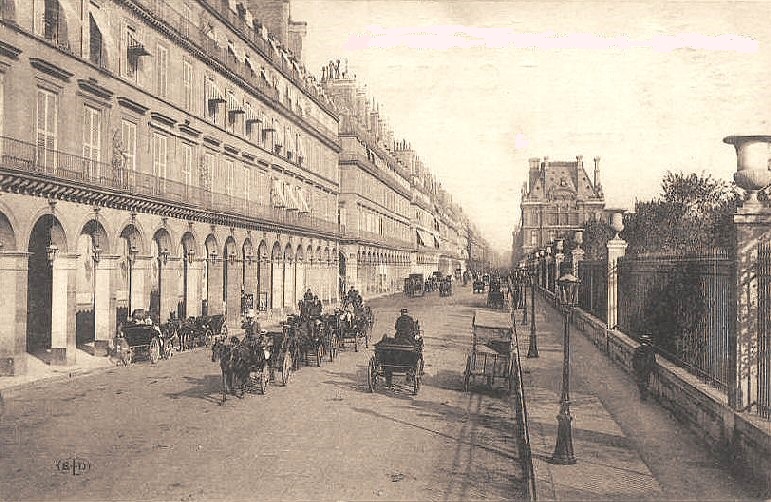
Not a lot of surprises in terms of the transport itself. Petrol-driven vehicles were still rare, especially in rural France, although they increased significantly during the period in question. Horse-drawn traffic was the norm on the streets and in the country areas, although cows were often shod and used as beasts of burden, too.
For longer distances, of course, the train’s iron network had spread throughout much of the country during the 19th century, for both passenger and freight transport. As in Britain, the rail network was superseding the canal system.
Paris’ biggest transport problem
But what do you think caused a huge crisis in major cities, including Paris, during these years? Answer: horse manure.
Paris counted around 80,000 horses in 1900. They left their inevitable calling cards behind them, and the streets were sometimes inches thick in dung.
Crossing a Parisian street was a hazardous enterprise. You took your life in your hands owing to the volume of traffic and lack of controls, exacerbated by the appearance of motor vehicles and an unregulated tram system. Pierre Curie, who won the Nobel Prize with his wife, Marie, for their work on radiation, died in 1906 after falling under the wheels of a horse-drawn cart.
Even if you didn’t get knocked down, you had to negotiate the coating of manure and endure the smell. You can only guess at the state of people’s boots and the hems of women’s dresses after being trailed across the street.
Added to this was the public health hazard, especially in the summer, caused by flies attracted by the manure, which then spread diseases. By the end of the 19th century, to address the problem, the city council was mobilising almost 4,000 people early every morning to clear the streets, armed with brooms and shovels.
The car takes over
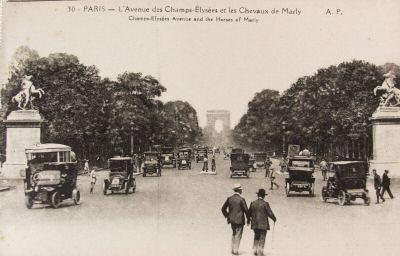
In 1907, to deal with the traffic problem, the council introduced experimental traffic lanes in the Champs-Elysées, one of Paris’ busiest thoroughfares. Cyclists and horse-drawn vehicles had to keep to the sides, while motor vehicles occupied the centre lane.
A Figaro newspaper correspondent lauded this initiative, noting that the central lanes were clean and dry. He added, “It’s easy to draw the conclusion that, from a hygiene point of view, cars, which give off fumes rapidly absorbed into the air, where they disappear, are greatly preferable to horse-drawn vehicles.”
Even so, the Prefect of Police introduced a law fining motorists if their vehicles belched out smoke. To start with, some thought this unfair, holding to the view that these fumes were not unhealthy since they didn’t persist, unlike the effects of the horse manure. Little did they know.
The motor vehicle rapidly took over from the horse-drawn variety in Paris. In 1898, 288 cars were registered in the city. By 1900 this had more than doubled, to 688. In 1905, this figure had multiplied more than seven times, to 5,056. The last horse-drawn omnibus was withdrawn from service in January 1913. By the time World War I broke out in August 1914, the streets’ coating of horse manure was a fading memory.
You might also like:
From Rural France to Paris: les Bougnats
Emma Calvé: Forgotten Singing Star of the Belle Epoque
Copyright © Vanessa Couchman 2019. All rights reserved.
 Vanessa Couchman
I was reading a novel, The Prince of Graustark. It was published in 1914. In it an account of the major characters being driven by chauffeurs through the Bois trying to lose someone tailing them. They were pulled over and taken to court immediately. New laws had just been inacted about speeding. They were very strict. I would love to find out more about the laws
LikeLiked by 1 person
Thank you for commenting. I must admit that it’s several years since I researched and wrote this post, and I didn’t look specifically at speed limits. However, I looked up this link, which has a useful table at the end listing the speed regulations by year. https://fr.wikipedia.org/wiki/Histoire_de_la_r%C3%A9glementation_de_la_vitesse_sur_route_en_France
What seems surprising is that all speed restrictions were lifted in 1921 and not reintroduced until the early 1960s. The link gives the history. It can be easily translated in Google Translate if necessary.
LikeLike
Thank you for responding so quickly. I will try to figure out how to translate the French. It has been nearly 50 years since I took French, and although some times I get the “gist”, I would really like to understand better. The Book that I referred to was published in 1914. I find it interesting to see what the people of the time thought about the time they were living in, not what we think about what they should have thought. This story is part of a series about an imaginary principality located north of Budapest and east of Vienna called Graustark. In this book two royals have been traveling incognito. They have not revealed themselves to each other. They are being pursued by someone, and tell the chauffeur to drive faster and lose the car behind them. They are stopped just as they are about to exit the Bois by two policemen on bicycles. They are upset by the newly enacted regulations in Paris. The “new” law provided for imprisonment in newly constructed special prisons. They, the chauffeur, and footman are escorted directly to the court. They are told that they will be immediately tried, and that the police are the only witnesses. Their real names will be posted on bulletin boards in the Place de l’Opera, the Place de l’Concorde and other places in addition to jail time. They do not have a right to appeal. It could actually result in longer jail times. The prince is willing to serve time, but does not want to reveal his name, not does the young lady. There is mention that this was a new regulation, and the it had been enacted in May. I was trying to find out if this was May of 1914 (publish date) or before. It intrigues me. The author when writing this story did not know that in a few months the Great War was about to break out. I was just trying to see how people really thought about things at that time. Was this an actual law?
LikeLiked by 1 person
Sorry. The article is long and written in sometimes quite technical French. If you scroll right down to the bottom, there is a chronological table of speed limit regulations. The ones in force from 1893, by decree of the Prefect of Police, were 12km/hr for motor vehicles (except in deep countryside, where it was 20km/hr). According to the chronology, there was no further change until 1921, when the restrictions were removed altogether throughout the country, i.e. no speed limit. This would seem to imply that the regulations in force in 1914 were still those of 1893. Prefectoral decrees carried the force of law. I can’t find any reference to a new decree or law dating from 1914.
This would imply that either the author was using creative licence in indicating a new law that fitted with the story, or that there was some kind of local by-law applicable in Paris in reality. But I find no mention of the latter.
I realise this isn’t a definitive answer to your question, but I hope it gives some context.
LikeLike
yes. The books were written as if they were current. I believe they were supposed to be in Paris in 1913 or 1914. The first book published in 1901 talks about the princess Yetive as getting married in the late 1890’s. The book I’m referring to is about her son who was 22 in the story.
Thanks for your help. I love looking at the details of history.
Thank you again
LikeLike
Just one further point. The regulations of 1893 were established in August of that year, but they did change previous regulations that applied to all vehicles. In May 1866, the speed limit was fixed at 20km/hr, but that date was far too early for motor vehicles to be in general use. So I don’t think it’s May 1866 that the author of the novel is referring to. Although the novel was published in 1914, it could possibly be set at an earlier date, e.g. the late 1890s or 1910s.
I looked up the author and note that the first book in this series was published in 1901. He seems to have been very prolific. Several films were make of the Graumark books. I don’t get any further clues to the date, though.
LikeLike
My dad could remember the problems caused by horse manure in the streets! There were still plenty of horses around when he was growing up in the early 1920s. Fascinating blog, as ever.
LikeLiked by 1 person
I can remember the rag and bone man coming along our street with a horse and cart in the early 1960s – real Steptoe & Son stuff! Horses gradually got pushed out of the main cities, but hung on in smaller towns for a long time.
LikeLike